
I’m of the opinion that it’s possible to approach art (or life) from many angles. Accepting or rejecting; optimistic or pessimistic. It kind of depends on the mood you’re in, or in a more deterministic way, how you choose to approach at the time.
Although I generally come in with a critical view I can appreciate the other modes. The critical approach can open discussion to weed out scrappy behaviour and pitfalls. In the digital world it is an invaluable method for troubleshooting or debugging code, allowing for progression, fewer errors, more stable ground. Approaching from a less critical ground can find the connections, wonder and beauty that is present at this moment, also allowing for progression.
Given that we are in the digital world here, that means binary choices (or, approaching it differently, 16 choices if we choose to discuss the digital world in hexadecimal, but that would complicate my argument). Thus, binarily we could choose how we want to approach what is going on here.
We could look at this group collection as a series of ephemeral images, falling to pieces through the sieve-like holes of their pixels. My own work for instance, flat, dimensionless, full of error and repetitive. Lyall’s collection, a manic attack with app-laden filters like a kid in a digital playpen. Why the almost identical nature of Sameshima’s series? Or the intentionally unclear visuals of Carapiet?
Flipping that switch, the nature of images within digital space could be the very question that is pertinent to address in the current process of photography.
Let’s take a less aggressive mode look at Lyall’s work. First some background though. I first met John Lyall 30 odd years ago. My first impression was of an intimidating but humour-laden intellect. Obsessed with tigers, or was it striped and spotted animals in general? Camouflage that just did not work in Aotearoan context. Not just animals but of the simulacra – the kitch, the transcendent, the naturalised, the compliant the domesticated. The feline shape as soft toy, blanket, bedcover converted to use as a tent. Perhaps a hide for animal spotting in the New Zealand forest. There are references I know I should make, but I know he’s playing – sometimes teasing, sometimes playing the fool.
At this point, I lost track of John for a while. It seems the obsession turned to the moa at some stage. A relic of a bird – unable to fly and already extinct. A New Zealand fable loaded with the cultural contrasts that Lyall seems to delight in. A tower of a bird but unable to survive the human onslaught. A bird that resembles our national kiwi, but also nods to the Australian emu. Lyall is Australian-born.
In Lyall’s hands, the moas here appear in various guises. From the museum specimen to the mechanical. From the backward looking (watching its back, and rightly so), to the stately. One seemingly wears feathery leggings. Another is outlined in fairy lights, shorn, festive and four-legged like a cubist party piece. Is this Lyall referring coyly to “Nu descendant un escalier n° 2”? (In another piece, the words Descent/descant appear like a Duchamp pun in progress). The references continue, although I continue to think I’m being played. I see dots all over the place, like Kusama, Litchenstein and Baldessari all came to play a digital game. The Ben-Day dots enlarged, the meccano obliterated by its own constructive devices. I have an early Baldessari image “Sketch for Fragment 9/20/66” on my wall, which shows a stylised plane made from over-large replicas of printing screen dots and this ‘reference to flying’ is resonating again with those moa.
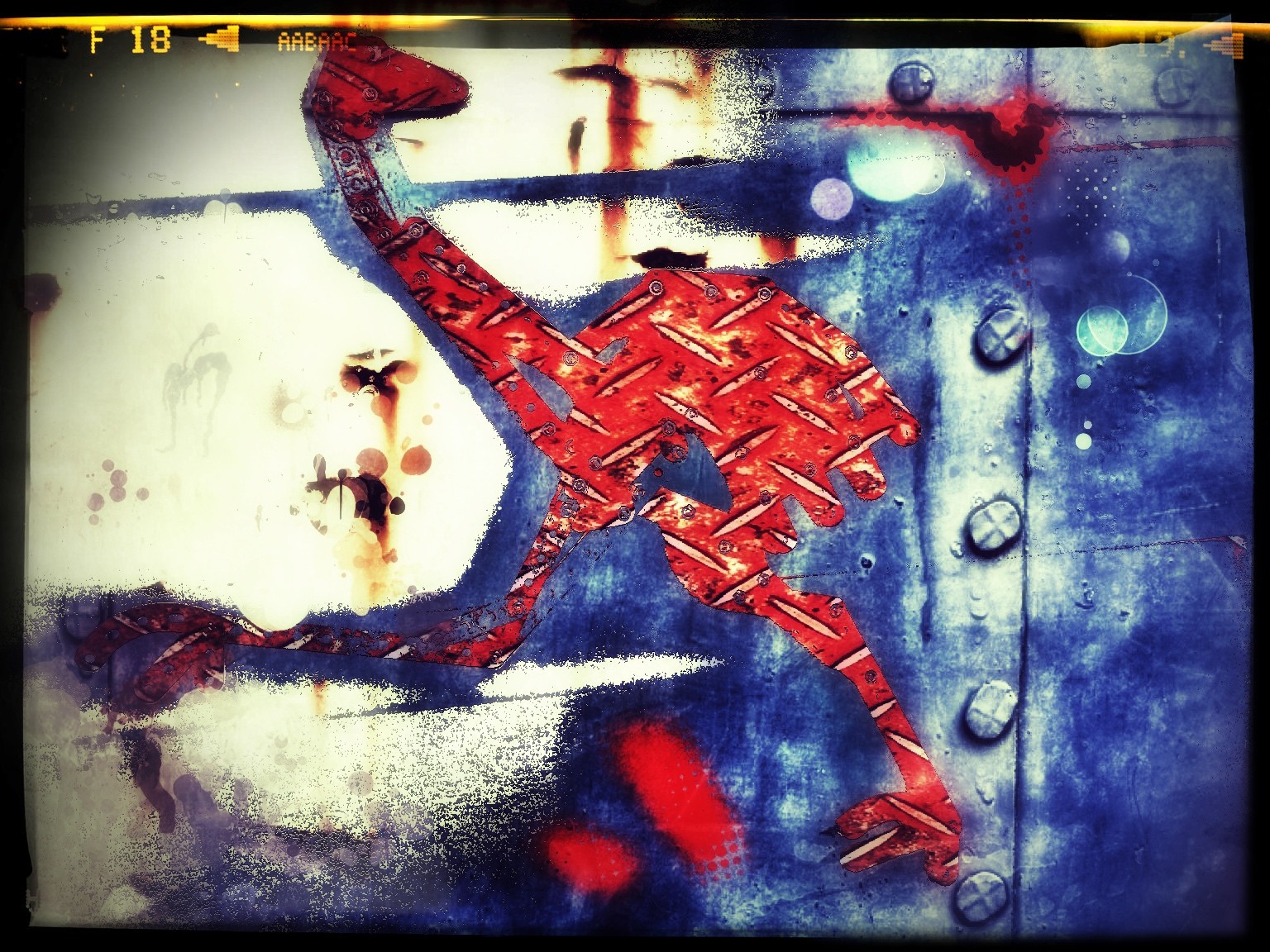
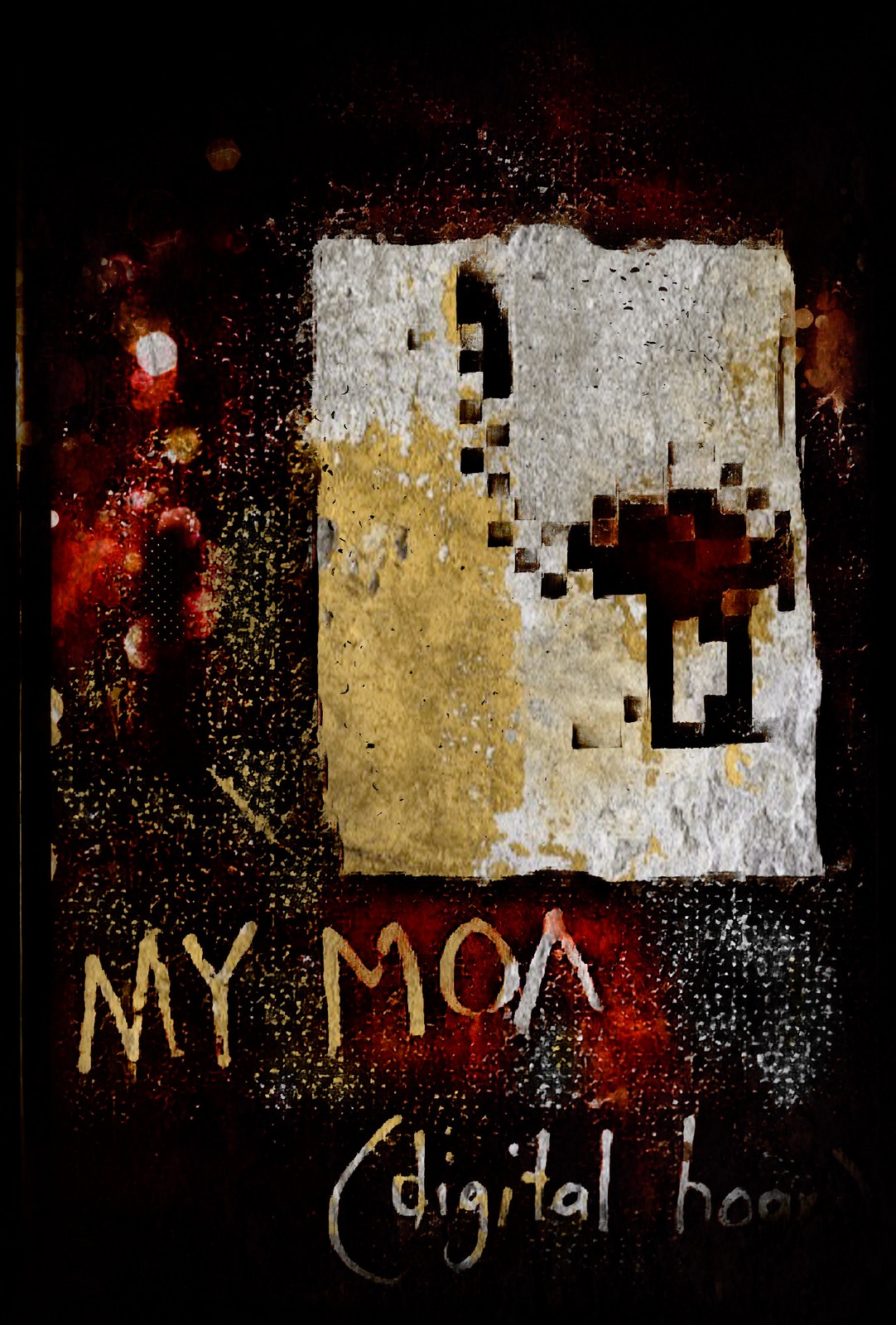
Now, I’ve got this far without mentioning the obvious – not only are there references aplenty but there are also filters aplenty. What appears to be happening is that Lyall is combing over this Moa obsession, with a backward eye to his previous work, and building new work that doesn’t just reference the digital era we find ourselves in but positively rubs our noses in it. I know this because he told me, but the meta-data confirms it – these images take the old works, or pictures of them in his home environment and squeeze them through Apple-based software in a way that is on-type. Gloriously playful, over abundant, enthusiastic like a kid with a new toy. This is the Antipodean equivalent of Penelope Umbrico’s delving into digital overabundance. In a similarly irreverent way, Umbrico (one of few visual artists who can look intelligently at digital culture and the way us analogue lumps of flesh attempt to assimilate it) took ‘Master’ works of landscape – signature images of mountains, and applied hundreds of phone-app filters to them, creating a dialogue across the analogue and digital, the sublime and the kitsch and a commentary on the history (and patriarchy) of photography.
Lyall similarly crosses the digital with the analogue in what might be humour laden but also, given *this* time of making, decidedly anxious. It’s like the game of life has got serious, its stakes suddenly much higher. Hunger games. A virus let loose in the digital medium. Lyall has moved into noir territory, the humour very dark.
The image that starts this series is a skeleton. The image that finishes it, a faux digitised moa, blocky on a background of dark fleshy indeterminancy hovering and stripped to its one-bit skeleton. A joke with a serious punchline.
Noir is a common trope of sci-fi online culture and hipster digital cool; noir connects young angst with unconscious anxiety and a very real fear of dystopia and end-times. The extinct moa, once assured and uncaring of its lack of flight, taken down by obvious weaknesses.
Visually, Lyall has caused a flattening, a removal or transformation of information with these filters. The camera-based image almost always has a referent, but here the real is only one aspect in the image and at that it can’t clearly be discerned. The original has been layered, colour-jammed, bordered and saturated. But Lyall gives us all the clues we need to unravel again. His titles reference the final image but included are the background elements. Not only that, but the history of the referent and part of its historical use in previous cultural life.
It’s like he is thinking of the virus, of the life, of the need for a retrospective, and rather than waiting for some curator to come along, he’s done his own – retroactively – and at the same time, (and like the extinct moa) brought the work back to life, or at least back to its simulation, which, again references his long history of simulacra. Rather like the idea of reengineering dinosaurs from remnants of dna and putting them in a theme park. The works get to live another life in a new era, and despite their age, are able to give voice and critique to the cage they have appeared in.
The old becomes new again, the analogue becomes digital and swings back. The cibachrome becomes glossy screen. It seems like Lyalls work continues, in true greeny recycling enthusiasm, to be feeding on, and re-using its components, as well as vying for new outlets, this digital form being probably only one.
John Lyall is a visual artist with a career stretching back to 1978 and an extensive list of exhibitions internationally. Australian-born, he studied and practiced in Australia and England before moving to Aotearoa. He works in photography and installation, and spearheaded sound performance group People Who Hit Things. His cyber-opera Requiem for Electronic Moa was included in SoundCulture 1999. Lyall works with numerous media, generally in a conceptual way, retaining a sense of humour and acerbic wit along with numerous art historical references in his work.