
on evidence, as the photographic is shown online
Stu Sontier 2021/22
“We cannot conceive of a more impartial and truthful witness than the sun, as its light stamps and seals the similitude of the wound on the photograph put before the jury” James Jackson, Georgia Supreme Court judge, 1882
“Most of evidence is but the signs of things. Spoken words and written words are symbols…. So the signs of the portrait and the photograph, if authenticated by other testimony, may give truthful representations… The portrait and photograph may err, and so may the witness. That is an infirmity to which all human testimony is lamentably liable’’ Chief Judge Charles J Folger 1881
“Photography played a large role in the cold war – some things that were just myths we were able to prove, some things that were rumours we were able to disprove. Photography is, sort of – the indisputable truth very often.” Jonna Mendez former Chief of Disguise at the US Central Intelligence Agency (quote – transcribed from youtube) 10 Dec 2020
Circumstantial evidence relates to a series of facts other than the particular fact sought to be proved. The party offering circumstantial evidence argues that this series of facts, by reason and experience, is so closely associated with the fact to be proved that the fact to be proved may be inferred simply from the existence of the circumstantial evidence.
Legal Dictionary21
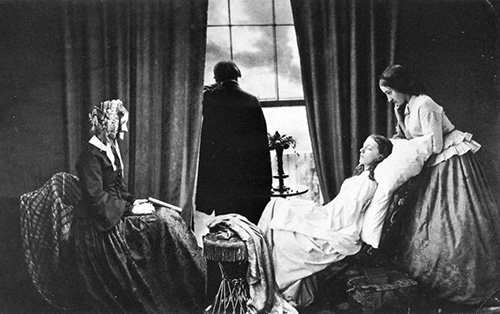
An example of Peach Robinson’s combination printing22
From CCTV stills, traffic control and monitoring systems, to photo-reportage, the digital image plays a major role as ‘‘evidence’’.
A Life More Photographic; Mapping The Networked Image Daniel Rubinstein + Rebecca Sluis23
Much of photography’s history implies that questioning its capacity for truth-telling is a recent thing. The most obvious discourse about photography’s ‘post-truth’ subjective state perhaps stems from the post-modern notion that the truth is mutable rather than fixed.
We’ve been led to believe that early photographers thought of images purely as acting like ‘the pencil of nature’ as per the book by Henry Fox-Talbot from 1844. But controversies from photography’s past show that the truth value of photographs has always been in question.
In the mid-1800s and beyond, whether courts could accept photographs as direct evidence was fiercely debated. Some naïve commentators, such as judge James Jackson (see left), did think of them as direct transcripts from reality, extrapolating from Fox-Talbot’s quote “the mere action of Light upon sensitive paper” to mean that they were exact truth-carriers. Others though, were quite aware of the deficiencies.
Jennifer Mnookin in the Yale Journal of Law notes a discussion from 1869 where Dr H. Vogel described “We often hear from admirers of Photography that this young art represents the pure truth” and goes on to describe “the complexities of proper lighting; those instances in which a decent photograph could be achieved only by retouching the negative; and finally, the distortions that resulted from rendering natural colors in shades of gray”.1
Others described to the courts the problems with perspective, etc and the need for external verification of the image and its contents.
Certainly by 1899 an appeals court could note “We may assume that everyone now understands the limitations upon the use of the photograph. It presents but one point of view, and may sometimes make an unfair representation of the points at issue.” 2
At much the same time, photographs of ‘spirits’ were providing incomes and those of ‘fairies’ were dividing opinions. Even the creator of the logical (if fictional) detective Sherlock Holmes – Sir Arthur Conan Doyle – came to the defence of a photographer of spirits in a court case,3 whilst others tried to argue that it was easy to fake spirits on the photographic print.
So, even very early in photographic history, the complex nature of photography was in debate. The combination photographs of Henry Peach Robinson were seen as controversial in their construction4.
The question of veracity in photography was firmly in the mind of both the public and the courts early on, and yet similar questions are still raised today.
Digital / Analogue
More recently, photography theorists and commentators have attempted to put the publics’ mistrust in photographs down to the introduction of digital machines. Curator Sarah Greenough stated “The invention of digital photography forever shattered the medium’s hold on truth,” in a catalogue essay for the 2015 exhibition ‘The Memory of Time: Contemporary Photographs at the National Gallery of Art‘.5
Talking to the Guardian, war photographer Donald McCullin “said the digital revolution meant viewers could no longer trust the truthfulness of images they see.” 6
If photography’s ability to tell a truth is both self-evident and in question, has this really changed with the introduction of the digital camera?
Theorists refer to the photograph having indexicality – it is bound to some real object and indexes it. Whether this is done with a film camera or digitally, if the purpose is to tell a truth (e.g. for forensic purposes) then it appears that a similar job is done with both.
Some theorists accuse digital photographs of merely being data, somehow applying metaphysical powers to the grains of silver that make up film and silver gelatin paper, whilst downgrading the pixel because of its digital form.
But these silver grains are just as much a transformation of information as the journey of light to bytes – neither is immutable. Image editing tools allow for quick modification, but much like old forms of collage, doing it well and undetected takes more time and skill. What’s more, numerous tools are available (and becoming increasingly sophisticated), that allow digital manipulation to be uncovered, well beyond what is easily visible. In fact it is likely that manipulated digital photographs are more easily and quickly checked for fraud than their printed cousins.
In “The Routledge Companion to News and Journalism”.7 Bonnie Brennan uses the example of the Abu Graib images to counter the implication of public distrust in digital images. It was initially attempted to keep those pictures out of the public eye, such was known to be their documentary and evidential power. Those digital images could be verified and traced and ultimately such traceability led to prosecutions and serious accusations against the abuse of prisoners in Iraq. These ‘point and shoot’ images from 2004 continue to resonate, be referenced (and misused).
Looking at the secondary manipulations that occur through photographer bias – in capture, cropping and contextualising – these options remain open to film-based and digital techniques.
Where we may differ with the digital is in the comparative ease of manipulation with digital editing. That is, the cost of acquiring and manipulating an evidence-carrying image is much higher with film, and thus digital allows entry to less wealthy players and manipulation may be more common.
Interestingly, with regard to information content, digital also raises a further spectre of the circumstantial. The ability to zoom in on pictures is a movie trope nowadays. Digitised images make this even easier. Detail in all parts of the image can be navigated, and inferences made from these details. Dangerous, embarrassing or incriminating evidence can be found in such details, some that the photographer may have overlooked. Details that, more and more, are recoverable through digital imaging techniques. A simple example is the sometimes surprising amount of detail that can appear in the shadows when a RAW file is processed to open up dense areas. A more complex one would be the recovery of reflection detail in the pupil of an eye. Photographer Penelope Umbrico makes use of this concept in her images of tv sets for sale on craigslist, where ghostly visions are found in the reflections from the screens. 8
Although the process of verifying manipulated images has been necessary since well before digital tools were available, the increasing dispersal of still and moving images in many settings has required more human and computing power for verification.
At the same time, the emergence of deep-faking – the manual or AI-assisted ability to switch facial and other features in a photograph or video clip (even, now, deep-fake speech) – makes the complex notion of belief in the image even more difficult.
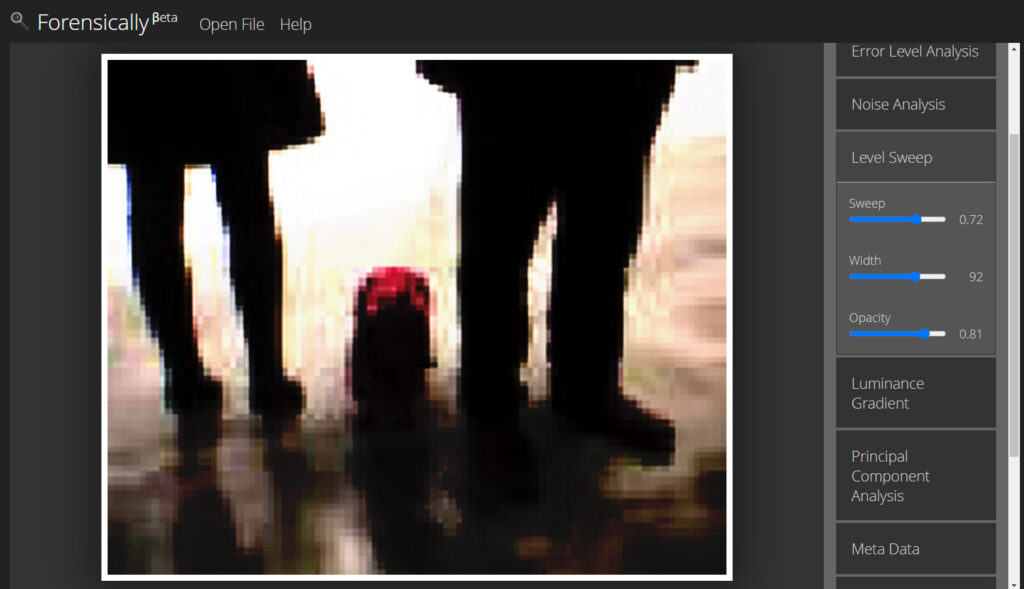
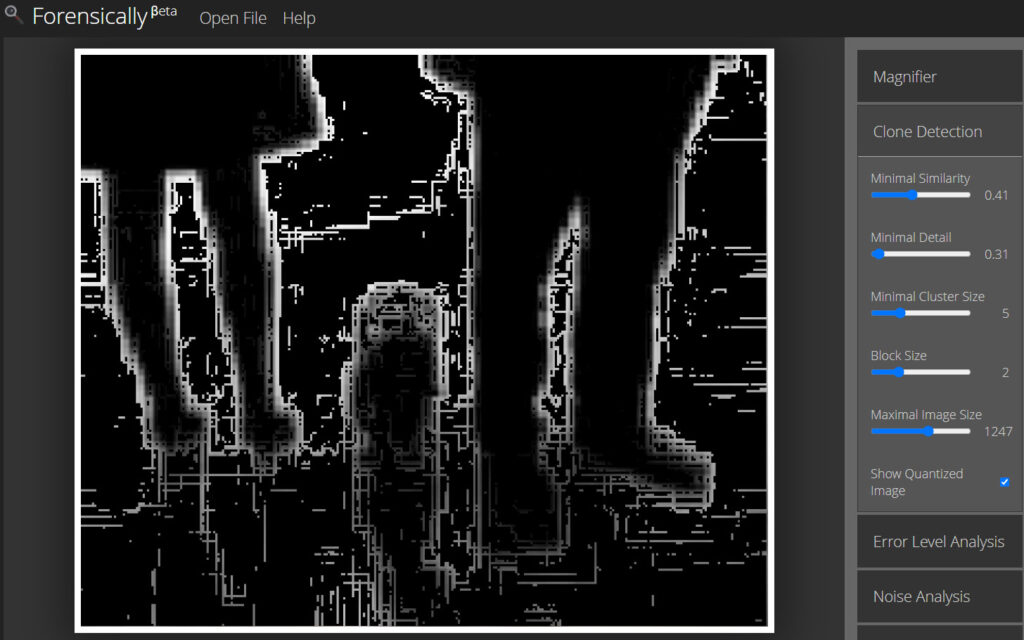
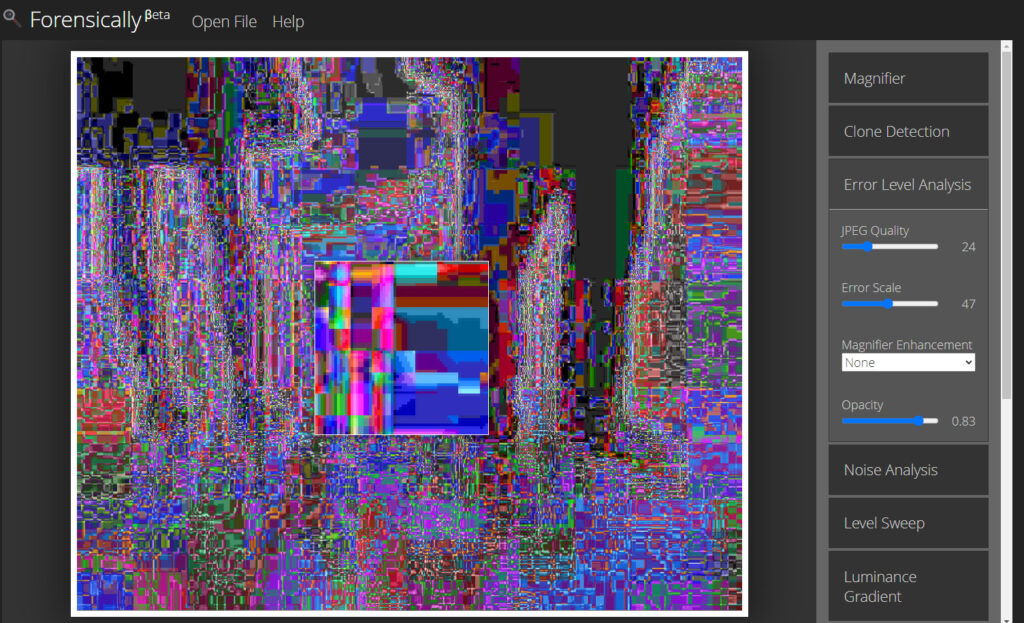
Analysis can be via examination of the image content but goes far beyond the visual. Areas of a jpg file that have been cloned, lightened, smoothed or otherwise altered can be discovered by computational techniques that are available online to anyone. They can show where tonal qualities or pixel resolution don’t match.
The online analysis tool Forensically9 uses noise, luminance and other image-derived information to show various manipulations. No doubt tools used commercially and by governments are much more sophisticated.
Research in 2019 at MIT has shown that indistinct objects in images can be reconstructed by A.I. that has been trained to understand how elements in an image come to be blurred10.
MIT has also created an imaging system that can literally see round corners by using light reflected from walls and other objects11.
Although these techniques could be said to add a hyper-reality to the digital or digitised image, forensics works by considering the digitally recovered information to be heavily linked (indexed) to reality even though not observable by eye.
In analysis of digital and analogue images, interrogation can be a much more convoluted process, where information is reconstructed through comparison, interpolation and other coded techniques, or by the combining of information from multiple images or multiple sources.
The independent research collective Bellingcat12 develops and uses open-source tools for both verifying images and video, and for using visuals (as well as mapping tools and various other data) to verify other information. They analyse pictures individually (examining shadows to gauge time of day, signage and other content to assess location, metadata for geo-coordinates, image editing clues etc) or collectively (cross-referencing image details across multiple images and sources to verify conflict reports or to disprove Russian misinformation, for instance).
There is strong evidence then that the digital image contains more of a connection to reality than the analogue.
The Digital exhibition and stored information – metadata
So what are the implications for the pictures on this site, presented on screen as a digital exhibition? What can be inferred by the exhibition as a whole?
One stated purpose is to showcase work by five Aotearoa photographers who, in their own ways are strongly aware of the evidential content as well as the personal elements and interests in their own work. The second purpose is a meta-analysis of putting the work into a digital, networked space.
That analysis can start simply – the channel used to host the exhibition holds information – the url and the home page, the menuing and the ‘look’ the site presents all give fixture to the images. The titles of work and image captions along with the artist essays similarly tie each series together. The simple context outlined by text may be laid out clearly, but we can go much more deeply than this.
We could go beyond just the website and search for what the rest of the internet can tell us about the artists – about the previous conceptual shows of French, the fine print and publishing background and interest in notions of culture and tourism of Sameshima. Lyall’s art provocations and his investigations of image filters can be found by rifling through social media, while Carapiet’s fracturing of the image can be contexuralised with his political advocacy. Interestingly only Sontier has a website but although an artist’s site provides a starting point, one should not always take artist’s own words at face value. This is just one form of circumstantial information that may or may not provide some clarity.
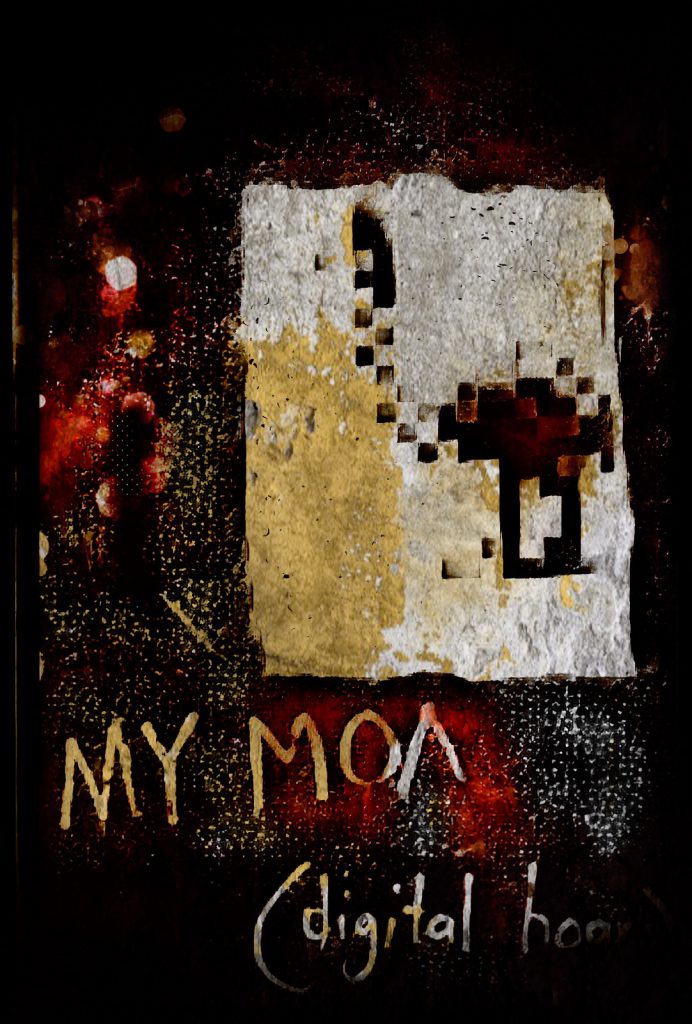
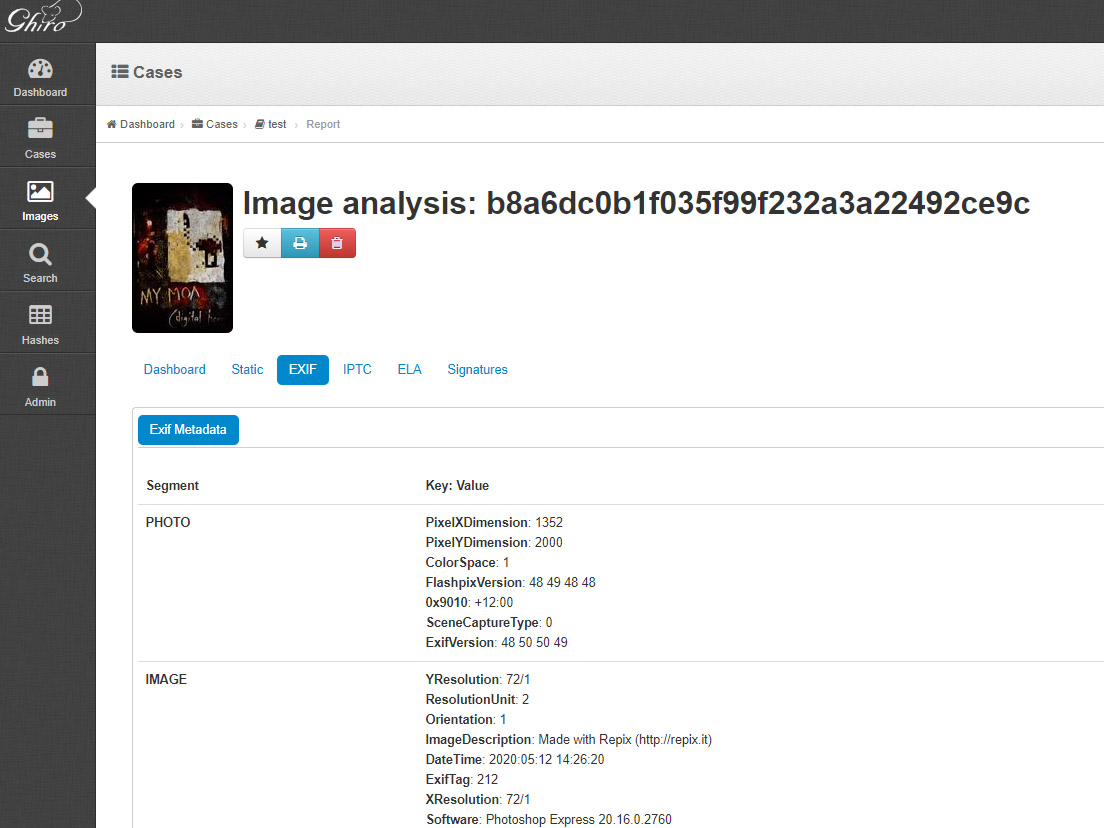
If metadata was left in the images we may be able to see the date, time and location the image was made and whether any image processing was done as well as camera make and the settings used.
The resolution of the images and the presence or absence of watermarks, or systems that limit downloading can tell something about the interest in preserving copyright and ownership of the images. In some ways, the digitally created image is much more open about its indexicality and its lineage.
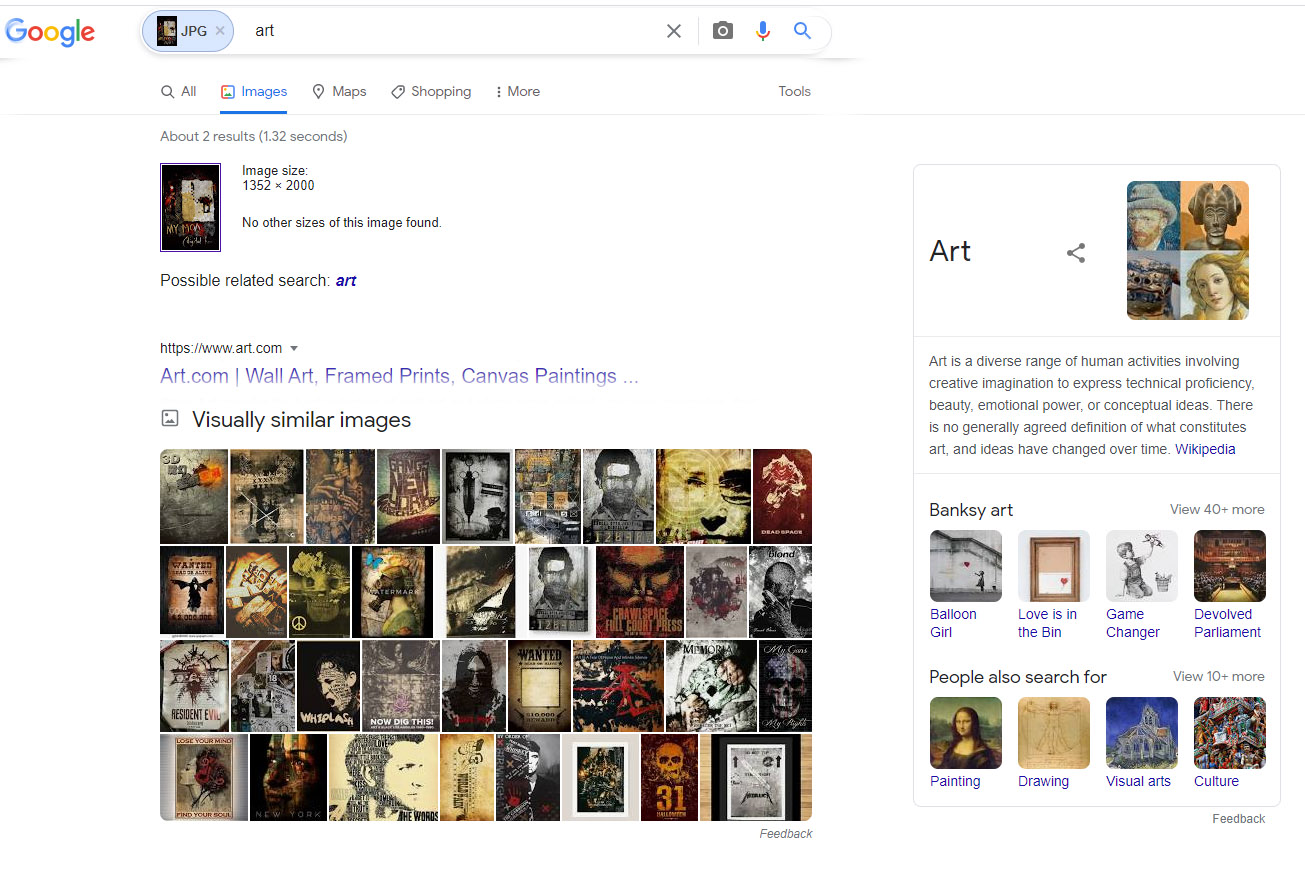
Online tools abound that allow one to check the authenticity of an image. Global image searches can often show where pictures (or parts of pictures) were used, or live in stock libraries or social media accounts.
The digitised image can thus reveal an expanding field of information.
What is the evidence that is held within a picture? Context
The notes above on the courts’ attitude to the veracity of images shows both a sophisticated awareness of issues, and an unwillingness or inability to define a complete truth in images.
A police-made forensic image is taken to have been produced by a trained worker whose intent is to convey specific information. Although the quality of information may be contested, it would generally be assumed that the intent is to show useful neutral information. An image on a propagandistic blog page is more likely to be up for questioning its truth value. An advertising image would generally be read as having been constructed or manipulated and having manipulating qualities, while an image in a newspaper showing a natural disaster would be seen as likely to contain more reliable information. In all these cases, the context the image is made for (and how it is seen) has a large bearing on how its truthful nature is perceived.
Edward Weston, when asked what is a photograph stated ‘a revelation … an absolute, impersonal recognition of the significance of facts’.13 Weston seems to imply that the photograph is not a collection of facts, but that it points to the existence and importance of facts. The photograph signals that it contains evidence of something; what that something is, is open to question. My contention is that once the photograph has signalled to a viewer that, yes, “here are facts”, the context is a way that information is extracted. It may require the personal knowledge or experience of the viewer to understand it though. For instance, an image of a jagged wound, sent to a doctor’s office shows the intent to pass on information about an injury. That information becomes useful and defined when it is accompanied by a note outlining that the wound is on the leg of my son and from broken glass. A second picture from a different angle will have different information, it might show more context, defining the shape and depth of the wound when viewed in relation to the first.
The book Evidence14 was important on its release in 1977 because it made context, or lack of context, explicit in the reading of images. Captions and titles were eschewed and the result is almost free floating, relying purely on the subject/ive to convey meaning. Images with wings, cut loose from their normal use and given relevance only by reference to personal experience.
Interestingly, if one happens to have a personal connection with the circumstances shown in any of the Evidence photographs, and can read the original context, the images become less interesting but much more factual. Marco Breuer, (who works non-representationally with the materials of photography) has described the loss he felt on finding himself within an environment similar to one of the Evidence images – “My relationship to one of the images in the book has changed … I now know too much about this scenario to appreciate the image for its other qualities.”15
‘Evidence’ (the book) then, is perhaps the epitome of the image as pointing to the importance of facts. The facts are unclear, but the notion of importance is written all over.
In the online world as well as the real world, it is very easy for images to resemble those in Evidence. Context is easily stripped. The meaning of pictures is changed when they float free. A box of family photos has particular meaning to the family members, and a somewhat different, diminished meaning to a biographer. But imagine the box, thrown out (as they often, seemingly are), found and resold at a flea market as a collection of vernacular pictures (as they often, seemingly are). A picture with a caption on the rear ‘Aunty Anne, Paris, 1954’, or ‘Doug riding mechanical horse’ might find their way into any number of art-based vernacular collections.
A Flickr picture with the description ‘My dad, nailing boards on treehouse’ might find itself emerging in image searches on ‘treehouse’ and ‘dad’. Or perhaps find its way into an AI training dataset for treehouses, hammers or males. Or, if the licence permits, used as a header image for a diy website. In each case, the image undergoes transformation or loss of information.
When photographs are shown in exhibition, the context can be more slippery. Stemming from a personal history, the art photograph is often meant to evoke more subjective states, although meaning can be directed by captioning, writing and other information.
The author of this essay and the photographers here are well aware of the potential for their images to be extracted, copied and posted, emailed or otherwise removed from the context of this exhibition. Presenting work online opens it to this loss. This is what we shall learn later about when Hito Steyerl refers to ‘the poor image’ that is delinked and floats through the network.
Photography has a more than a tenuous connection with telling stories though. Forensic photography is used to gather information with which to present later in court. Such photographers are trained to try and present visual information in the most balanced way they can: avoiding distortions and shadows that might hide detail; capturing scars and tattoos that could help identify a body.
With enough intent, both could be faked – added or removed from both photo or body. For most situations though, the value would not be high enough and the photograph could be judged to be unmanipulated.
As well as forensics, some professions rely on the ability of photography to contain accurate information. Dental photography can assist with both oral work and insurance, for example.
But photography’s truth-telling power has not always been for the better, or even neutral, as Charlotte Cotton points out16 – “Photography has been implicated in criminalising social resistance…; as evidence in support of eugenic theories; the vehicle for voyeurism and surveillance; the constructed visual endorsement of social elites; and the hubristic records of colonial and imperial power”. Interestingly, painting and sculpture have also shared some of these characterisations, for instance in valourising colonial and class structures.
Photojournalists have to navigate the problems of evidence and bias. Sometimes their very livelihoods are threatened by the perception of either showing reality, or applying bias to that show. Protest crowds may well not want identifying images of themselves especially if the police may be given access to them.
The accuracy of photography is not always so clear, or expected.
Advertising and illustrative pictures in newspapers or magazine articles are often expected to have less accuracy, or even be directly misleading. Social media images, especially if they involve such things as dog face filters or obvious beauty mode, are widely read as ‘ironic’ (or irreverent, or irrelevant). We’ve been embedded in the online for long enough that most of us quickly read these images as throw-away, or at least ascribe less importance to their factual content.
What of other online images?
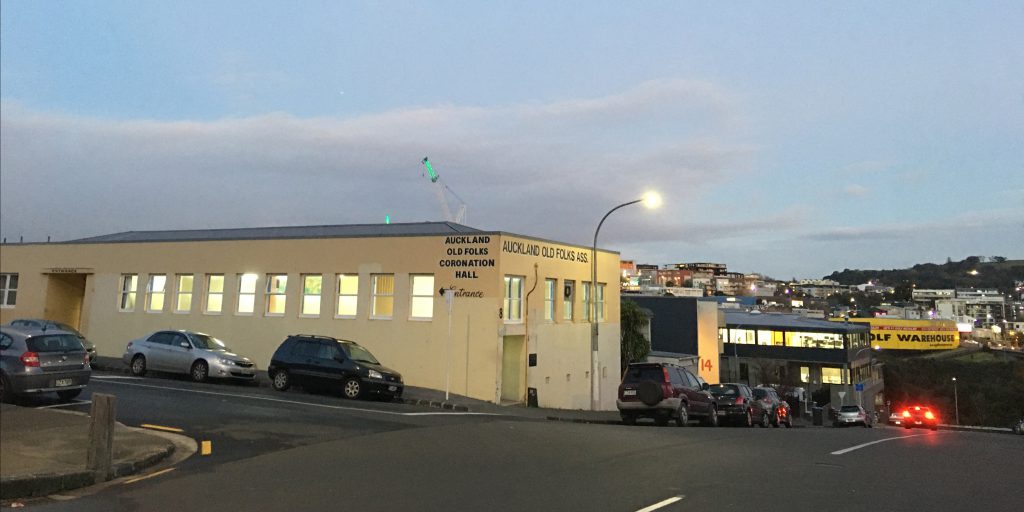
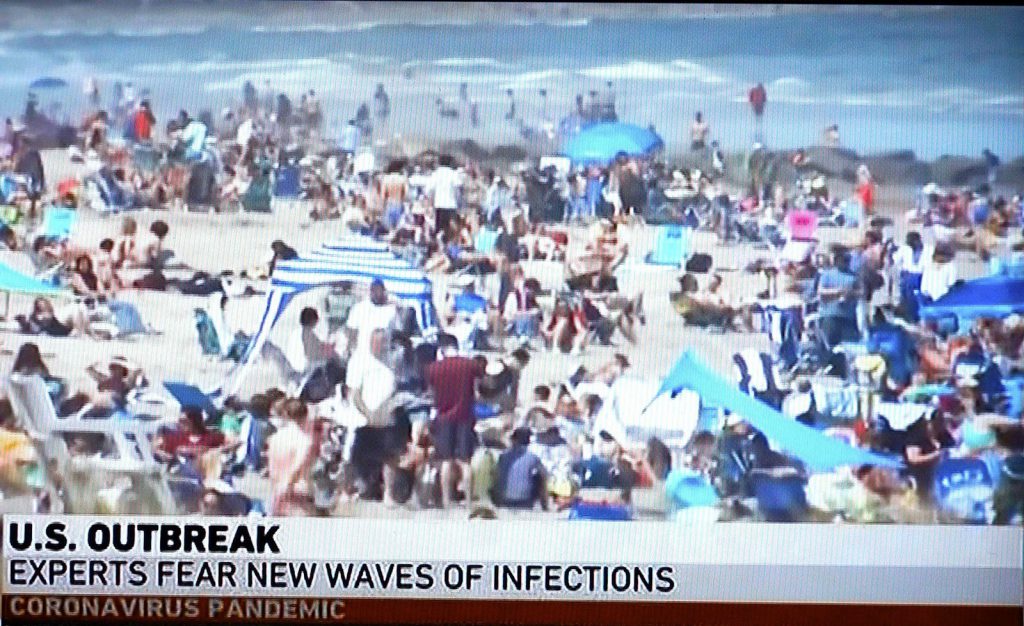
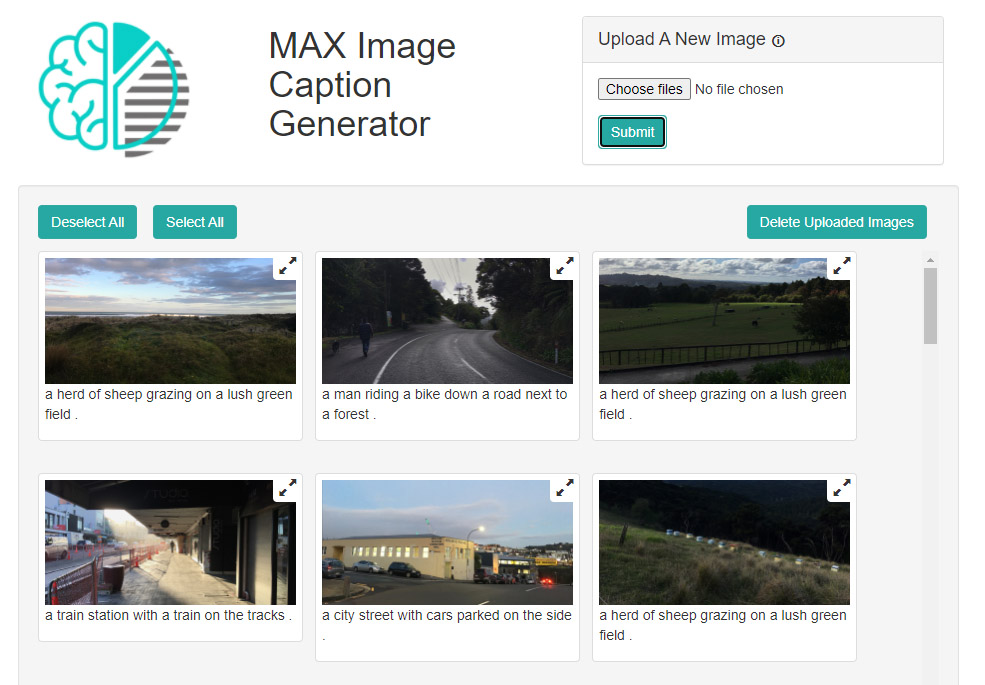
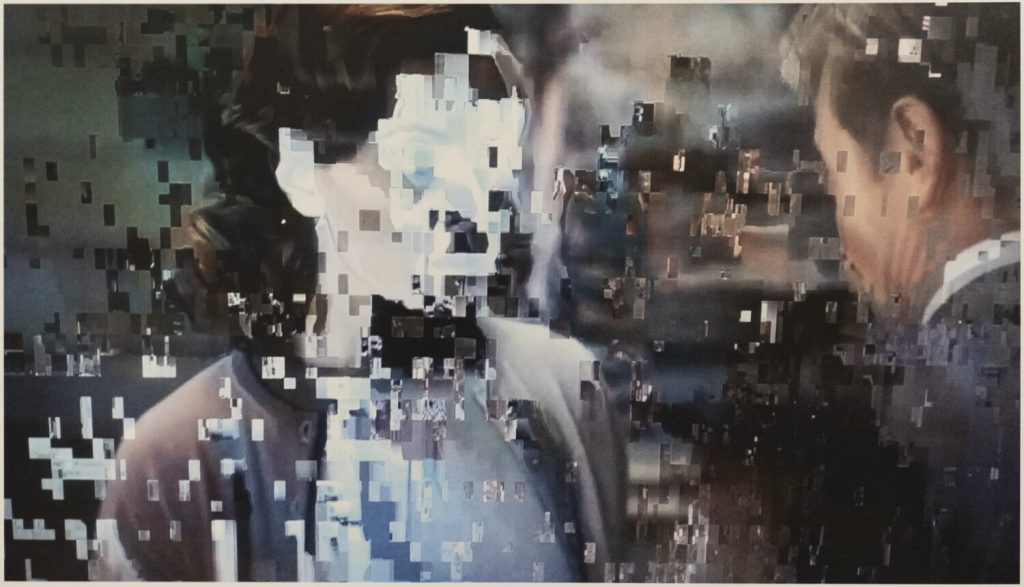
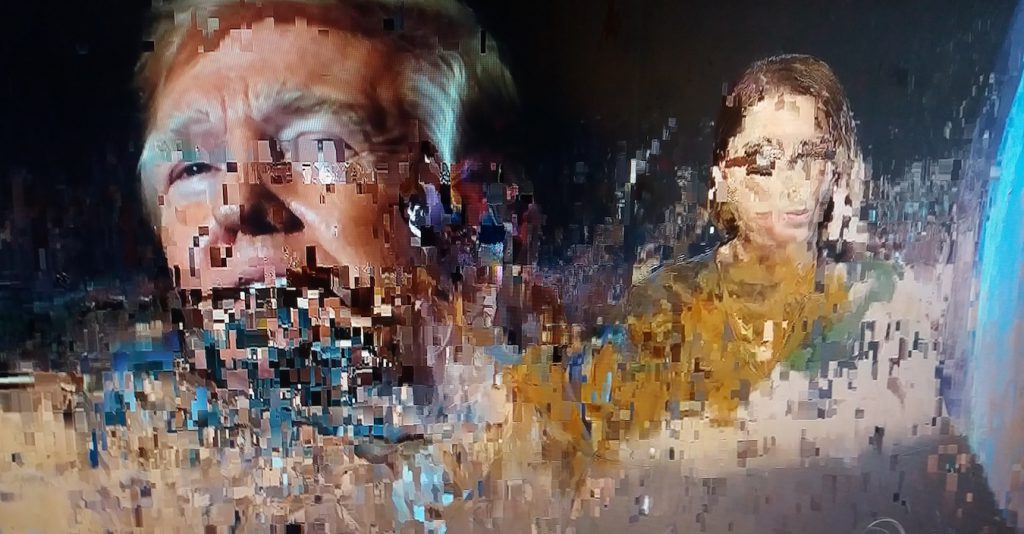
Poor Image
In her treatise on the poor image Hito Steyerl cries “please, anybody—show me this real thing” in relation to what she terms “the networked image”17. These poor images are moving and still pictures that circulate online in and out of context, degraded through app algorithms, over-zealous editors (striving for speed in their websites), remixed and reworked.
We get our fix of images, visual art and cinema from our small screens, our magazine rendered copies, our cropped social media platforms, our books with their colour-incorrect reproductions. Steyerl talks about the poor image not as an outcast but something we all know of and take into account. The loss of quality becomes a marker, the pixellation its own aesthetic.
The photographers here are aware that reproduction equals loss of information and that online images can be unleashed from their original context. The latter can be considered but not controlled whilst the former is something that photographers have grappled with since jpgs could be uploaded. Some will fight the loss of detail fidelity and colour accuracy. Others accept that this also remains out of control and they might even embrace the change of attitude.
Most of us know Ansel Adams images only through books, where even gravure reproduction compresses the tonal space and often cripples the shadows when compared to the prints. The mechanical press created the original ‘poor image’, which was also networked (in a slower sense), transmissible to a mass audience who could not view the original.
Even with the best reproductions, many images are shown at significantly less than original size. Detail, no matter how carefully dealt with, is lost with shrinking size. Many have had the annoyance of reading descriptions of objects within a reproduced image, only for those details to be almost unviewable at the printed size.
In the case of book reproductions and the screen-based image, we adjust our expectations and the savvy viewer almost automatically assesses the extent of quality and information loss that might have occurred in the transference of the image to ink or pixels.
When we turn to the image in an internet-based gallery, how the gallery chooses to show its works must be taken into consideration. Images may be presented singly in long columns on plain pages, in slideshows or in 3D galleries where the image can be panned and zoomed. But in all cases it remains constructed of pixels on a flat 2D space. The online gallery, with its ‘poor jpg images’ is as real as the secondary nature of images in magazines or books. The images are still read within their surrounding context.
The notion of a perfect, unmanipulated image appears to be predicated on perfect human vision in a narrowly defined cultural window that expects sharpness and detail. Indeed, black and white has been long associated with a documentary style, but the loss of colour information is a significant transformation that appears almost overlooked at times. A lens and colour film capture a section of the electromagnetic spectrum, similar but not the same as the human eye. Film and paper, camera, optics, screen resolution and colour gamuts are always attempts to approach ideal human vision but they inevitably fall short. Information or evidence is lost in those gaps.
——
In this exhibition, with its reference to evidence, what is being said by each voice in different ways is that the notion of the photograph as evidence should be treated with distrust. Some of the photographers may lure you into taking their pictures at face value. Some are literally taking the image apart and questioning the apparatus and the delivery.
To ask whether an image has been manipulated or not implies that there is some perfect notional image, from which derivations are made – a ‘rich’ ideologically correct picture.
Carapiet’s images might be said to have been manipulated through their poor transmission over broadcast television. On the other hand, the images are straight evidence of the lossy nature of that medium. These images are documents of what appeared before the camera.
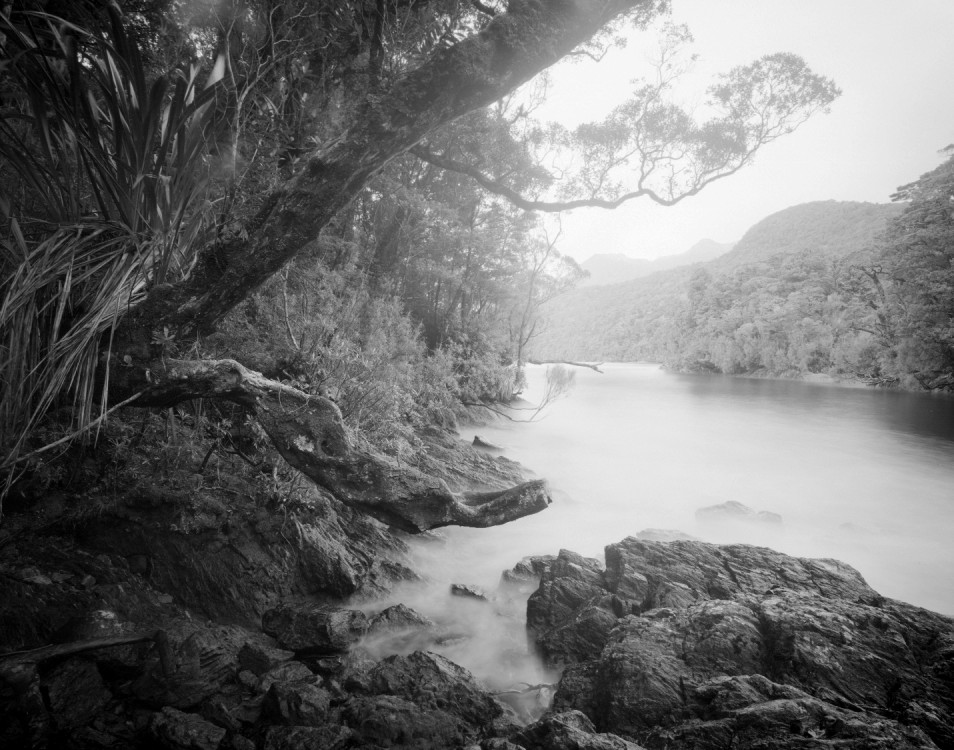
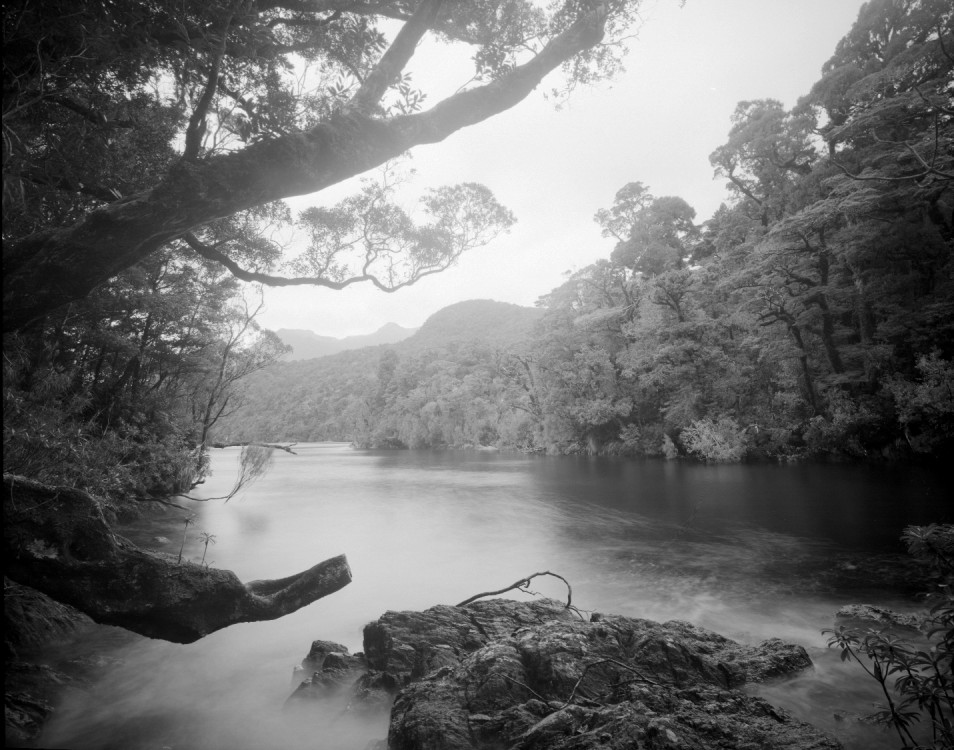
Sameshima’s pictures have a classic black and white documentary approach but would be more helpful to botanists if colour was used. That isn’t the point of the pictures of course, where they evoke a more subjective notion of landscape.
The point is – every image is a manipulation at an aesthetic/political level. French’s and Samaeshima’s work here, then, while more ‘representational’, are just as much manipulations as those of Carapiet’s. On one level, Carapiet is making a formal evidential account – essentially unmodified. In French’s case, a scene is stilled by exposure time and digital sensor. Some internal camera processes occur (even within the RAW file she starts from). Some post-correction is added. The image goes through compression to jpg and then comes over the network, resized onscreen and shown to you. Carapiet’s images, arguably, go through fewer steps. He shoots direct to jpg and applies minimal intervention – clarity at this level is not required.
Photographic imaging in the future
One conclusion here is that while the introduction of digital images did not substantially alter the truth value of images, it alerted a larger number of people to the potential for image manipulation. It is possible though that current and future computational photography will significantly change the notion of evidence.
For a number of years digital cameras have had the ability to apply weight to certain elements in the image based on coded notions of ‘best picture’ or ‘best settings for scene’. For example, the in-built coding in many camera scene modes adjusts contrast and colour saturation and can emphasise a range of shades, such as increasing the saturation of green hues when a landscape is detected.
Cameras that delay the shutter release until eyes open or until everyone smiles affect the image in subtle and not so subtle ways and potentially remove some of the photographer’s intent. But cameras now are doing way more than this and often doing it beyond the awareness of the user.
Samsung is currently creating in-camera AI modified lighting, using software that attempts to better ‘light’ a scene according to the camera’s decision-making system. This AI system, trained with thousands of portrait lighting situations, can substantially alter the perceived subject lighting, and in a nod to the racial bias often found in recent datasets, it was trained with a wide variety of skin types.
Cameras can build combination images at the release of the shutter, where the final picture is a combination of several parts of other images, collecting the smiling faces and open eyes in each to build the perfect final image.
Camera manufacturers are offering the aspiration of the pro-photographer for the price of their latest model. It’s a trend that started even before lens auto-focus and auto-exposure modes, when Kodak said “you press the button, we do the rest”. Understandable from the manufacturer perspective but it evokes the player-piano approach to music.
In the near future, cameras may start inserting image-parts taken from the network or AI generated segments, not associated with the actual scene. In 2019 Huawei was accused of just this with its ‘moon mode’ although it was seemingly never proved.18
These interventions in images may be more dangerous in the sense that there may be no ‘originals’ to compare with, no way to detect post-take manipulations because there are none, no suspicious groupings of cloned pixels or other indications of change, because the ‘altered’ picture is the original.
The New Yorker outlines camera computational trickery in an article that questions whether the iPhone 12 Pro is going too far in its smart systems. One photographer is quoted as referring to the results as “over-real”. Another asks Apple to “make it less smart”. 19
How will ‘citizen journalist’ phone camera images be dealt with for evidence? Will news organisations be more careful about using combination-images? Will we see radical differences in camera images of a news-worthy event that has been photographed by many observers, using various brands of phones with different algorithmic decisions?
Recently, AI processes have made text-prompted machine-created images relatively easy, and these will become more and more attuned to reality whilst completely disconnected with reality. It will likely soon become possible to edit an image with voice or text commands which rely on AI interventions – “change weather to sunny”; “make subject happier”; “use this portrait of me, with more hair, on a climate-submerged atoll”.
AI is also finding its way very quickly into many automated image tasks such as caption creation and the construction of images from a text description. Currently the public forms of such image generation tools such as Midjourney and DALL·E create more fantastical realities but one future use is in producing real-looking imagery for advertising and illustrative images and graphics.
In 2022, the question must be, what do photographs convey, as a result of their history and the societal understanding about them?
It appears that both film-based and digital images are currently able to convey a version of a truth, whilst still creating magic, epiphanies, part of a story. They engage with an individuals’ inner world and personal history. Photographs are able to deceive, deflect, denigrate or just create boredom.
We will have to become ever more sceptical and sophisticated readers of images.
Where does this leave us, with that original concept of evidence?
Circumstantial at best, photography was and is under constant analysis, and constant transformation.
What digital has done perhaps, is make the public more aware of the possibility that any image might have been manipulated.
In courts of law, the reliability of images is often questioned. Outside of courts, we constantly assess the truth-level of images. Those images come under scrutiny and require validation and are trusted as far as we can build a readable context.
The level of unconscious analysis of image/context will have to increase in the public. Perhaps flipping from a bias of believability, to a starting point where every image is seen as possibly constructed, and each will have to ‘prove’ it’s veracity.
Gary Winogrand is famously quoted as photographing the world ‘to see what it looked like photographed’. He less famously said “The photograph isn’t what was photographed. It’s something else. It’s a new fact. “20 Perhaps he is pointing out that the world, stilled and examined, is different from its examination in passing real-time. Once we have the ability to stop it and look for as long as we like, something new is revealed.
In similar ways, the photographers here make these images for their own contemplation of certain facts. They are interested in the particular elements that make photography unique but go beyond the literal reality, examining not just the way things look when photographed, but the way they do so in light of a half century of intense scrutiny, in light of technical developments that have complicated the nature of the image and the nature of evidence. They use photography and turn it on itself so that the evidential content talks about the nature of photography itself.
Here, photography is examined at a deeply personal level – ‘what is the context of this image that made me want to make it’? The existence of photographs and their complex information starts to comment on the existence of the photographer within a complex environment.
These photographers are interested in the objects they have created and how they comment on themselves as well as the situation documented. Whether film or digital, whether shown online or on paper, their object-nature remains. The information contained within directs their scrutiny, attached to their personal narrative. They read their own images in a unique way, unavailable to others because their personal histories are unavailable to others.
So while the essays and other contextualising provide some entry-points, what is valuable direct evidence for the photographer becomes circumstantial evidence for others.
references
1 ‘The Image of Truth’ – Yale Journal of Law and the Humanities vol 10.1 Page 22 https://digitalcommons.law.yale.edu/cgi/viewcontent.cgi?referer=https://www.google.com/&httpsredir=1&article=1181&context=yjlh
2 ‘The Image of Truth’ – Yale Journal of Law and the Humanities vol 10.1 Page 51 https://digitalcommons.law.yale.edu/cgi/viewcontent.cgi?referer=https://www.google.com/&httpsredir=1&article=1181&context=yjlh
Court citations: Jennifer L. Mnookin, The Image of Truth: Photographic Evidence and the Power of Analogy, 10 Yale J.L. & Human. (1998). Available at: https://digitalcommons.law.yale.edu/yjlh/vol10/iss1/1 [accessed 2022-06-10]
3 https://www.bbc.com/news/uk-england-leeds-55187973
4 https://www.inthein-between.com/henry-peach-robinson-and-the-combination-print-before-digital-2/ [accessed 2022-06-10]
5 https://www.nga.gov/press/exh/3911.html [accessed 2022-10-15]
6 https://www.theguardian.com/artanddesign/2015/nov/27/don-mccullin-war-photographer-digital-images [accessed 2021-02-15]
7 https://www.routledge.com/The-Routledge-Companion-to-News-and-Journalism/Allan/p/book/9780415669535 [accessed 2022-06-10]
8 http://www.penelopeumbrico.net/index.php/tvs-from-craigslist/ [accessed 2022-06-10]
9 https://29a.ch/photo-forensics/ [accessed 2022-08-02]
10 https://news.mit.edu/2019/model-lost-data-images-video-1016 [accessed 2021-02-17]
11 https://web.media.mit.edu/~raskar/cornar/ [accessed 2021-02-17]
12 https://www.bellingcat.com/about/
13 Ellsworth Kelly, Photographs – 2016 Aperture
14 Evidence, Larry Sultan and Mike Mandel 1977
15 https://aperture.org/editorial/marco-breuer-mike-mandel-larry-sultan-evidence/ [accessed 2021-02-15]
16 Charlotte Cotton, The Photograph as Contemporary Art
17 Hito Steyerl, In Defence of the Poor Image https://www.e-flux.com/journal/10/61362/in-defense-of-the-poor-image/ [accessed 2021-02-17]
18 https://www.newyorker.com/culture/infinite-scroll/have-iphone-cameras-become-too-smart [accessed 2022-07-21]
19 https://www.photographytalk.com/huawei-moon-mode-might-be-fake [accessed 2022-07-21]
20 https://www.artforum.com/print/reviews/200301/garry-winogrand-1964-3945 [accessed 2022-02-08]
21 https://legal-dictionary.thefreedictionary.com/circumstantial+evidence [accessed 17-2-2022]
22 https://www.inthein-between.com/henry-peach-robinson-and-the-combination-print-before-digital-2/ [accessed 2022-10-15]
23 https://www.researchgate.net/profile/Daniel-Rubinstein-5/publication/299854265_A_Life_More_Photographic_Mapping_The_Networked_Image/links/5706544308aec668ed95c92a/A-Life-More-Photographic-Mapping-The-Networked-Image.pdf?origin=publication_detail [accessed 2022-02-08]
24 Photographs as Evidence Aaron Meskin and Jonathan Cohen https://aardvark.ucsd.edu/perception/agnosticism.pdf {accessed 2022-10-28]